
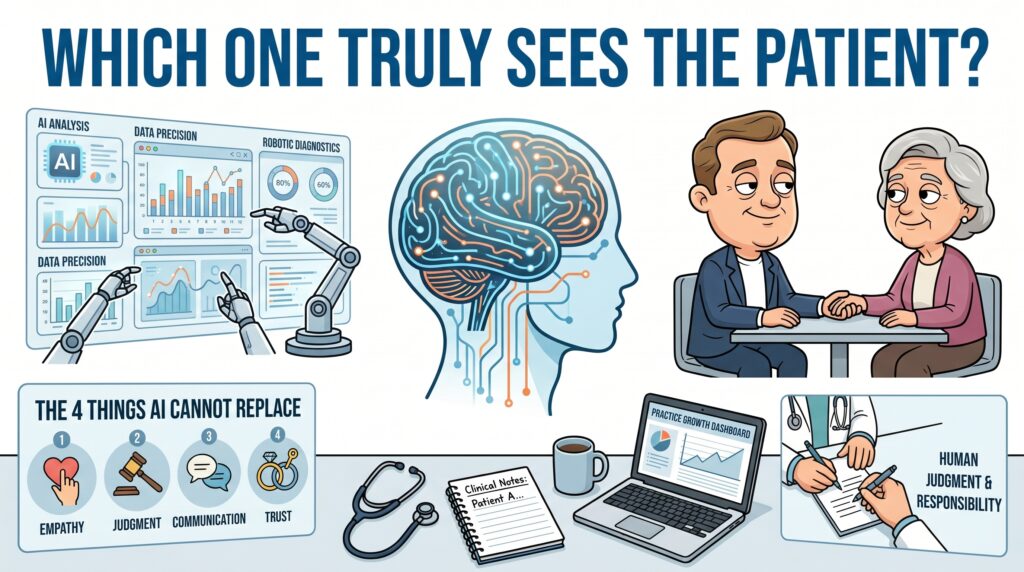
Imagine sitting across from a patient whose test results show nothing unusual. Blood work: normal. Imaging: clear. Vitals: stable. On paper, everything is fine.
But something is off.
You can feel it in the way she answered your first question — a beat too quickly, like she’d rehearsed it. You notice that her partner didn’t come with her today, even though they usually do. You catch the slight hesitation before she says “I’m fine, really” — and something in your clinical instinct says: that’s not the full story.
So you stay with it. You ask one more question. And that’s when she tells you what’s actually been going on.
That moment — that specific, deeply human, impossible-to-programme moment — is the diagnosis that artificial intelligence still cannot make.
And it happens to be one of the most powerful competitive advantages you have as a healthcare professional in 2025 and beyond.
What AI in Healthcare Actually Does Well (And What It Doesn’t)
There is no question that AI in healthcare is transforming medicine at a pace that even the most optimistic researchers didn’t predict five years ago.
AI diagnostic tools can now flag early-stage cancers in imaging scans with accuracy rates that rival specialist radiologists. Predictive algorithms identify sepsis risk hours before clinical symptoms become obvious. Natural language processing systems are dramatically reducing documentation time for busy physicians.
These are real advances. They save time. They reduce error. In many settings, they genuinely save lives.
But the conversation about artificial intelligence in medicine has a tendency to collapse into a binary that isn’t particularly useful: either AI is going to replace doctors, or it’s just a productivity tool that changes nothing fundamental.
Neither is true. And the truth in between is far more interesting — and far more relevant to your career.
The Gap Between Data and Understanding
Here is what AI in healthcare is genuinely extraordinary at: processing information at scale, identifying statistical patterns across large datasets, and surfacing probabilities that would take a human analyst weeks to calculate.
Here is what it consistently struggles with: understanding context, reading a person, holding ambiguity, and making judgment calls in situations that don’t fit a known pattern.
The gap between those two things is not a gap in computing power. It is not a gap that more training data will close.
It is the gap between information and understanding. Between pattern recognition and genuine clinical reasoning. Between processing a record and being present with a human being.
That gap is where your expertise lives.
The Part of Your Job AI Cannot Touch
When you walk into a consultation room, something begins that no algorithm has been trained to replicate.
You are reading the room before the patient has said a single word. The energy when you enter. Whether they seem relieved to see you or braced for bad news. The particular way they hold their body when discussing a certain symptom. The things they keep circling back to without directly addressing.
Cognitive scientists have a term for this kind of knowledge: situated cognition. It refers to intelligence that only functions in context — that cannot be separated from the live, relational, moment-to-moment experience of being with another person.
An AI model trained on ten million clinical records has never been in a room. It has access to descriptions of rooms. It has been fed the written residue of clinical encounters. But it has never experienced the quality of silence that falls just before a patient says something they’ve been afraid to say.
What Patients Actually Want From Their Doctor
Here’s something the data on patient trust in doctors consistently shows: what patients want from their physician is not primarily accuracy. They can Google accuracy. What they want is someone who genuinely sees them.
A study published in JAMA found that patients who felt their doctor truly listened to them were significantly more likely to adhere to treatment plans — regardless of the complexity of those plans. Not because the medical advice was better, but because the relationship was real.
No healthcare technology currently in existence can build that relationship. The human connection in healthcare — the felt sense of being understood by someone who has clinical expertise and also genuinely cares — is something that has to come from a person.
From you.
Why Human Diagnosis Still Outperforms Algorithms in What Matters Most
The question of human diagnosis vs AI often gets framed around accuracy rates. And on narrow, well-defined tasks — reading a chest X-ray, identifying a melanoma in a dermatology image — AI is impressively competitive.
But clinical medicine, as most doctors know, is rarely a narrow or well-defined task.
Real medical decision making happens in conditions of incomplete information, emotional complexity, cultural context, and genuine uncertainty. It requires you to weigh probabilities against values. To understand not just what is statistically likely, but what is right for this specific person, in this specific situation, with this specific life.
The Four Irreplaceable Skills AI Cannot Replicate
1. Contextual Reading The ability to perceive what isn’t being said — to catch the gap between a patient’s words and their meaning — is built through years of clinical experience. It requires a nervous system, emotional attunement, and the capacity to be genuinely present. AI produces outputs. Physicians produce understanding.
2. Adaptive Reasoning Under Uncertainty Medicine regularly requires decisions before the full picture is available. Physicians are trained to form working hypotheses, act on provisional certainty, and update their reasoning as new information emerges. Most AI systems are trained to return the most statistically probable answer. Those are fundamentally different cognitive operations.
3. Accountability-Based Authority The trust a physician earns is not credential-based. It is consequence-based. It comes from having made real calls, lived with real outcomes, and continued to show up anyway. That weight, that track record of genuine accountability, creates a form of clinical authority that cannot be simulated or downloaded.
4. Emotional Precision Years of delivering difficult diagnoses, of holding a patient’s reality without either inflating it or abandoning them in it, produce a communicative skill that is profoundly rare. It is the difference between information that is technically accurate and communication that actually helps. Emotional intelligence in healthcare is not a nice-to-have. It is the core of what makes medicine work.
The Hidden Cost of Handing Too Much Over to Technology
One of the most important — and least discussed — limitations of AI in healthcare is not about accuracy. It is about dependency.
When clinical professionals begin to outsource the cognitive heavy lifting to AI tools, something subtle begins to shift. The instinct to probe further before looking at the algorithm’s suggestion. The willingness to hold a diagnostic question open when the data is ambiguous. The habit of trusting your own clinical read when it contradicts the statistical probability.
These capacities are built through use. And they atrophy through disuse.
The risk is not that AI makes medicine worse in the short term. The risk is that over-reliance on AI tools gradually erodes the very skills that make physicians irreplaceable in the long term.
AI tools for doctors are at their best when they are used the way a consultant uses a registrar: to handle the groundwork, the synthesis, the preliminary analysis. The clinical judgment — the final call, the nuanced communication, the human relationship — must remain with the physician.
You are the consultant. The AI is your registrar. That distinction matters more than most people currently appreciate.
How Doctors Can Use AI Without Losing Their Competitive Edge
The goal is not to resist healthcare technology. The goal is to integrate it strategically, in a way that amplifies your clinical intelligence rather than replacing it.
Here is a practical framework for doing exactly that.
Use AI for speed, not for judgment. Let AI tools accelerate the tasks that don’t require clinical nuance: documentation, research synthesis, appointment management, data organisation, first-draft communications. These are areas where speed matters more than the kind of deep contextual reading that only you can provide.
Maintain the raw diagnostic habit. Before consulting an AI diagnostic support tool, form your own clinical impression first. Write it down if it helps. This is not inefficiency — it is cognitive maintenance. The generation effect in cognitive science shows clearly that thinking something through independently before seeing an external answer dramatically improves retention and reasoning quality.
Let AI enhance your patient communication, not replace it. AI-generated patient education materials, appointment summaries, and follow-up communications can save significant administrative time. But they should be reviewed, humanised, and personalised before they reach a patient. Your voice, your specific reassurance, your clinical framing — that is what builds the trust that keeps patients returning.
Use technology to expand your reach, not just your efficiency. This is where healthcare innovation and marketing strategy intersect in ways that most clinicians haven’t yet explored. More on this in the next section.
Turning Your Clinical Intelligence Into a Digital Advantage
Here is something that most healthcare marketing conversations don’t address directly enough.
The same qualities that make you an exceptional clinician — contextual awareness, adaptive reasoning, emotional intelligence, accountability-built credibility — are precisely the qualities that the digital marketplace is starving for.
The internet is saturated with health content. Most of it is technically accurate and emotionally hollow. Produced at scale, optimised for clicks, absent of the particular kind of wisdom that only comes from clinical experience.
How to Build Authority Online as a Healthcare Professional
This is the opportunity that the future of medical practice is quietly opening up.
Physicians who are willing to bring their clinical voice into the digital world — who share genuine insights, speak to what their patients are actually worried about, and communicate with the precision and warmth of a trusted practitioner — are not competing with AI-generated content.
They are in a completely different category.
A doctor who publishes a monthly article addressing the real questions her patients ask, who speaks on a podcast about the nuanced reality of her specialty, who uses video to demystify conditions that her community is anxious about — that doctor is building something that no algorithm can build for her.
A loyal audience. A trusted reputation. An authority that extends beyond the clinic.
The C.A.S.E. Framework: Your Clinical Edge in the Digital Age
At Infinity Medical Marketing, we work with healthcare professionals using a framework built specifically around the skills that clinical training produces. We call it the C.A.S.E. Framework.
C — Contextual. Your ability to read what an audience actually needs, beneath what they’re asking. Content that operates on this level doesn’t just inform — it resonates.
A — Adaptive. Your training to form hypotheses and iterate based on evidence, applied to content strategy, audience development, and business growth. Not one bet — a differential.
S — Situated. Your credibility is not theoretical. It is earned, evidenced, and felt by the people who engage with your content. No competitor can replicate a decade of clinical accountability.
E — Empathic. The communicative intelligence you’ve built through years of patient interaction produces content that people return to — not because it’s the most optimised, but because it’s the most human.
This framework is the foundation of how we help doctors, clinics, and healthcare businesses build authority and attract patients in the digital world.
What the Future of Medical Practice Actually Looks Like
The future of healthcare is not one in which artificial intelligence replaces physicians. The evidence, when examined carefully, doesn’t support that conclusion.
What the evidence does support is a future in which the value of different clinical competencies is redistributed.
The information-access layer of medicine — recall, pattern recognition, data synthesis — will continue to be handled increasingly by AI tools, and handled well.
The judgment layer — contextual reasoning, relational trust, adaptive decision-making, empathic communication — will become more valuable, not less, precisely because it becomes rarer as the information layer is automated away.
The physicians who understand this distinction now, and who begin building their clinical authority into a digital presence today, will be the ones who define what medical leadership looks like in 2030.
Doctors and AI are not in competition. But doctors who have built a trusted audience, a recognisable voice, and a digital presence that reflects the depth of their expertise will have an advantage that no amount of computing power can erode.
Frequently Asked Questions About AI in Healthcare
Can AI replace doctors? AI can replicate specific, narrow clinical tasks with impressive accuracy. It cannot replicate the contextual reasoning, relational trust, adaptive judgment, and emotional intelligence that define excellent medical practice. The consensus among both AI researchers and medical professionals is that AI will change the distribution of clinical tasks, not eliminate the need for physicians.
What are the current limitations of AI in healthcare? The most significant limitations include the inability to read non-verbal and contextual cues, difficulty functioning outside well-defined problem structures, the absence of genuine accountability, and the inability to build trust relationships with patients over time. AI systems are also trained on historical data, which means they are optimised for patterns that have already occurred — limiting their effectiveness in novel or atypical clinical presentations.
How should doctors use AI tools in their practice? AI tools are most valuable for administrative efficiency, research synthesis, documentation support, and first-pass data analysis. Clinical judgment, patient communication, and diagnostic decision-making should remain physician-led, with AI functioning as a support resource rather than a decision-maker.
Why is patient trust in doctors still so important in the AI age? Research consistently shows that patient outcomes — including treatment adherence, recovery rates, and health behaviours — are significantly influenced by the quality of the patient-physician relationship. This relationship depends on felt trust and genuine human connection, neither of which AI can currently produce.
How can healthcare professionals build their online presence without compromising credibility? By focusing on genuine, specific, expertise-driven content that addresses the real concerns of their patient community. Authenticity, consistency, and clinical depth are more valuable than production quality or posting frequency. Healthcare professionals who communicate the way they consult — with warmth, precision, and genuine investment in outcomes — build audiences that are loyal and referred.
What is Infinity Medical Marketing and how can it help my practice? Infinity Medical Marketing is a healthcare marketing agency specialising in helping doctors, clinics, and healthcare businesses build digital authority, attract patients, and grow their practices with purpose. We combine medical expertise with modern marketing strategy to produce results that are credible, compliant, and genuinely effective.
Building Your Digital Practice Starts Here
The most important insight in this article is not about AI.
It is about you.
You have spent years — possibly decades — building a form of intelligence that the market is only now beginning to recognise as rare and extraordinarily valuable. The contextual awareness, the empathic precision, the adaptive reasoning, the accountability-built credibility.
That intelligence doesn’t have to stay inside the clinic.
It can drive content that patients trust. It can build an audience that refers. It can position you as the most credible voice in your specialty online. It can grow a practice, a brand, or a business that works as hard as you do — and that continues working when you’re not in the room.
But only if you bring it forward.
At Infinity Medical Marketing, we help healthcare professionals do exactly that. We take the clinical intelligence you’ve already built and translate it into a digital presence that grows your reputation, attracts the right patients, and creates lasting authority in your field.
Ready to turn your clinical expertise into your most powerful marketing asset?
Book a free strategy consultation with Infinity Medical Marketing
Or explore more of our resources for healthcare professionals at infinitymedicalmarketing.net.
0 Comments